
Case study · Tulln an der Donau
Tulln brings neighbors together. From one pilot district to the whole city.
Tulln wanted more neighbors to get to know each other. The city tested Hoplr in one district: 36% of survey respondents made contact with neighbors they had not known before. After the pilot, Hoplr expanded across the city, with seven digital neighborhoods.
Connect5 min read
Original case study · English · 12 pages · 2.7 MB

Lower Austria · Austria
16,758 residents
2026
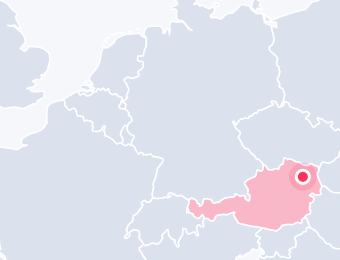
in Europe
- 36%
- of survey respondents got to know neighbors through Hoplr whom they had not been in contact with before
- 300+
- households registered in the pilot district: 22% of households in that area
- 85%
- of respondents rated recommending Hoplr to other districts from 7 to 10
Historical results from the 2025 pilot. Survey figures describe respondents, not all residents. The published case study does not state the final sample size or fieldwork dates.
Meeting people beyond your own circle of friends.
Through ‘Stadt des Miteinanders’, Tulln is working towards a city where residents know and help each other. The online platforms it had used before did not create the connections it wanted. Contact often stayed within existing circles. Large groups felt impersonal; on some platforms, advertising dominated.
Tulln wanted a place where neighbors could find each other for questions, help or company. Including people who had never met before.
Start with a pilot in one district.
In 2025, a personal letter from the mayor invited residents of the Tulln Südwest pilot neighborhood to join Hoplr. More than 300 households registered: according to the pilot evaluation, 22% of households in that area.
Meanwhile, the communications team spent two months testing the dashboard for local communication. The city evaluated both how residents used Hoplr and how it worked for its own staff.
36% of survey respondents got to know new neighbors.
In the pilot survey, 36% of respondents said they had used Hoplr to make contact with neighbors they had not known before. Stefanie Jirgal, Operations Lead for the ‘Stadt des Miteinanders’ initiative, explains how the city invited residents to join:
“It was important to us to put togetherness first from the moment the app launched. We therefore decided to encourage all residents to use it through a personal letter from the mayor, with great success.”
Translated from German
The neighborhood stories Tulln published in July 2026 show what those connections looked like. One new resident, for example, mentioned her love of knitting and received an invitation for coffee.
A story from Tulln
Anyone up for a walk?
A resident asked on Hoplr whether anyone felt like going for a walk that day. She suggested meeting at a bus stop. A reply soon followed: two people who had never met before went for a walk together.
After the pilot came the whole city.
The pilot survey asked whether respondents would recommend Hoplr to other districts, on a scale from 0 to 10. In the published chart, a rounded 85% gave a score from 7 to 10; the reported average was 8.4. The city subsequently expanded Hoplr to seven neighborhoods. Within these neighborhoods, residents can create smaller chat groups for their street or apartment building.
The expansion featured in the city newspaper, on the municipal website and in the local press. Residents received another personal invitation letter. According to the Hoplr article of 8 July 2026, more than 1,600 households joined in less than two weeks: 22% of all households in Tulln.
“Hoplr has proved a highly effective tool that fills a gap: it is a secure, closed platform for our residents. It enables us to foster togetherness and guide developments for the benefit of the community.”
Translated from German
The communications team valued the ability to target messages: a road closure notice could go to one neighborhood, while an event invitation could reach the whole city.
What can your municipality learn from this?
Test with residents and staff.
The pilot district showed how neighbors used Hoplr. At the same time, the communications team could check whether the dashboard suited its work.
Invite residents personally.
Tulln used a letter from the mayor, both for the pilot and when expanding across the city.
Ask what connections people are making.
The pilot survey looked beyond registrations: 36% of respondents had made contact with neighbors they had not known before.
Community starts with getting to know each other.
Tulln wanted residents to meet people beyond their own circle. The pilot showed that Hoplr helped: more than a third of survey respondents had made contact with neighbors they had not known before. That gave the city a reason to expand. The strength of the approach lies in combining an invitation from the city with residents’ own initiative: they turn a post into a walk, a meeting or a helping hand.
Share this story with your team.
Download the English case study about the pilot. This web article also covers the citywide expansion and the neighborhood stories that followed.
Download the case study