
Case study · Punt Welzijn
From a request for help to a neighborhood where people know each other.
Who can help with the shopping, the dog or the garden? In Weert, neighbors find each other through Hoplr. Punt Welzijn helped get the network started. Residents now arrange much of that help themselves and say hello to each other beyond the app.
Connect4 min read
Original case study · English · 6 pages · 1.5 MB

Weert · Limburg, the Netherlands
51,498 residents in the municipality of Weert
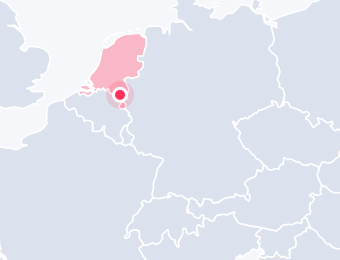
in Europe
- 2019
- Punt Welzijn starts using
the Hoplr neighborhood network - 5,500
- Active accounts reported
in the original interview - 100%
- Match between requests and offers of help
reported by Bouke Kouters
Interview published in January 2024. Bouke Kouters reported the matching rate; no measurement period or number of requests was specified.
Help is nearby. How do you bring people together?
After the pandemic, neighborhood worker Bouke Kouters received more and more requests for everyday help in Boshoven. Shopping, walking the dog, tidying the garden: for each request, he would look for someone who could help.
Punt Welzijn wanted residents to find each other more easily. Anyone who needed help should be able to ask their neighbors directly.
One place to ask for and offer help.
Punt Welzijn started using Hoplr in 2019 through the municipality. The Living Together team explained to residents how to use the neighborhood network. Volunteers and other neighbors could then see their requests for help.
Providing that guidance took time at first. Residents needed to get to know the platform and understand what they could use it for. In the January 2024 interview, Bouke reported that every request for help had found a match.
First a request for help. Then a familiar face.
The connections extended beyond the app. Residents who met through a request for help recognized each other later at the supermarket. Bouke saw it happening in the neighborhood:
“Neighbours now say hello to each other at the Jumbo or Albert Heijn. Online contact makes offline meetings easier.”
An idea from the neighborhood
An idea for a dance class.
A resident wanted to run a dance class but did not know where to start. Through Hoplr, she made contact with people in the neighborhood.
Neighbors arrange more themselves. The neighborhood worker saves time.
Where Bouke used to find a suitable helper himself, residents increasingly made those arrangements directly. He said that, after the work involved in getting started, this saved Punt Welzijn time.
Neighborhood workers also gained a clearer picture of local needs and talents. They could provide support where needed, while residents made their own connections.
“I don’t see Hoplr as a tool for us as an organisation. But rather as a tool for the neighbourhood, because neighbours can take it upon themselves to use it.”
Taking the initiative also fits with Punt Welzijn’s neighborhood work: the organization helps residents put their ideas into practice, while residents stay in charge.
What can your municipality learn from this?
Make requests for help visible.
Shopping, the dog, the garden: in Weert, these requests brought together people who had not known each other before.
Help residents get started.
The Living Together team took time to explain the network at launch. Residents learned where to ask for and offer help.
Let neighbors make their own arrangements.
As residents found helpers themselves, Bouke spent less time matching requests. The neighborhood worker continued to offer support where needed.
Neighborly help organized by the neighborhood itself.
At Punt Welzijn, connections start with something small: helping someone with shopping or gardening. Through Hoplr, residents find a neighbor who can help. They receive support and make new contacts, while neighborhood workers spend less time matching people. Weert’s experience shows the value of taking time to explain the network at the start: residents increasingly take care of those connections themselves.
Share this story with your team.
Download the original interview with Bouke Kouters and share Punt Welzijn’s approach with your colleagues.
Download the case study