
00 · Foreword
A neighborhood that connects people.
“Impact starts with your friends, family and neighbors. Aim to have a good impact within your own living environment.”
the leading role. Actual human beings don’t play a part in this story.
Yet technology should serve people rather than the other way around. The impact of social media and technology on our society is undeniable. More than ever, we are connected to like-minded people from all over the world, but at the same time we are losing touch with our immediate surroundings and neighbors. Also, not everyone has access to digital technology. Think of the digital divide between the ‘haves’ and ‘have-nots’ – the latter often vulnerable or disadvantaged groups. In the UK today, around 6 million young people do not have home broadband, a laptop or desktop.1 Another factor is that loneliness is becoming a worldwide epidemic, with around 33% of adults experiencing feelings of loneliness.2
Local authorities and organizations can make a difference. Through local community building, they stimulate informal neighborly help (supporting community members to help each other) and the circular economy as well (promoting much-needed sustainability through exchanging and giving away items and skills). Local residents can gain access to the information, local knowledge, spaces and informal support that are already present within the neighborhood – accessing and activating this social capital.
The more people get access to social capital, the better the neighborhood is able to tackle social challenges itself. The neighborhood becomes a resilient ecosystem, better equipped to withstand external threats such as a health pandemic, a food or energy crisis, criminal activity, or even a natural disaster.
Hoplr wants to make a tangible difference to neighborhoods with its digital neighborhood network and tools for local governments and community groups. That is why we are working on a formula that maps the social capital of neighborhoods year after year. Based on this, we can develop and evaluate neighborhood initiatives (bottom-up) and interventions (top-down) in order to unlock the immense potential of any local neighborhood.
In this white paper, we define a way of understanding the dynamics of a neighborhood’s social capital. Then we aim to help you both map and develop the local community’s value.
Jennick Scheerlinck, Founder and Chief Executive Officer, Hoplr
01 · The value of a neighborhood
The value of a neighborhood.
As soon as we are old enough to observe any potential downsides to social evolution – whether because of pollution from industrialisation, overconsumption from globalisation or information overload from digitalisation – we revert to the idea of the ‘good ol’ days’. It’s a tempting cliché, to blame change for the decline of our communities and social life, and yearn for faded memories of a ‘supposed’ golden era.3
Our relationship with our neighborhood is undoubtedly different today than it was in the past, but the neighborhood itself is by no means any less valuable. Later in the paper, we will illustrate that the local community holds a wealth of potential, perhaps now more than ever. But first we look for the cause behind this change in relationship with the neighborhood. We’ll find it within a transformation of our personal networks.
1.1 The role of our personal networks in the neighborhood
Networked individualism
Sociologists Rainie and Wellman coined the term ‘networked individualism’.4 In the past, our network used to consist of a few close-knit social groups in our physical proximity. Today, we are more likely to be part of numerous diverse groups with well-defined purposes. We may never even talk to or meet face to face with anyone in these groups. They may be groups with whom we explore our musical tastes, another that shares our political preferences or area of work expertise. Today’s society offers an immense buffet of communities, both online and offline, satisfying our conflicting hunger for both individuality and a sense of community.
Local diversity
As our identities and roles in society become more fragmented and not as intertwined with our local communities, neighborhoods are becoming increasingly diverse. People with completely different backgrounds end up living next door to each other. The neighborhood becomes a rich patchwork of diverse interests, talents, and cultural or religious beliefs.
In other words, under the influence of globalisation, urbanisation and the internet, the local community has evolved from a homogeneous group (where members have lots in common and behave similarly) to a heterogeneous group (with much diversity).5
1.2 Social capital of the neighborhood
Social capital
Every individual network and community contains a certain amount of social capital: the sum of resources that can be called upon, based on social relationships alone.6
Think of a friend who offers tickets to a concert when they can’t make it or a neighbor who drives you to an appointment if your car breaks down – it is everything your network can do for you (from an individual perspective) or the community for each other (from an aggregate perspective).
Bonding versus bridging
Both homogeneous and heterogeneous groups possess social capital, albeit in different forms.7 In the case of a homogeneous group, we speak of bonding social capital. It contains important value in the form of security and social support through a sense of belonging, among other things.
However, studies show that mainly capital within a heterogeneous group, namely bridging social capital, has a positive effect not only on individual outcomes, but also on economic growth and acceptance for diversity.
Bridging social capital of the neighborhood
Back in the day, local residents used to rely on each other as a close-knit (homogeneous) community. But now, each member can tap into their individual networks to better their neighborhood.
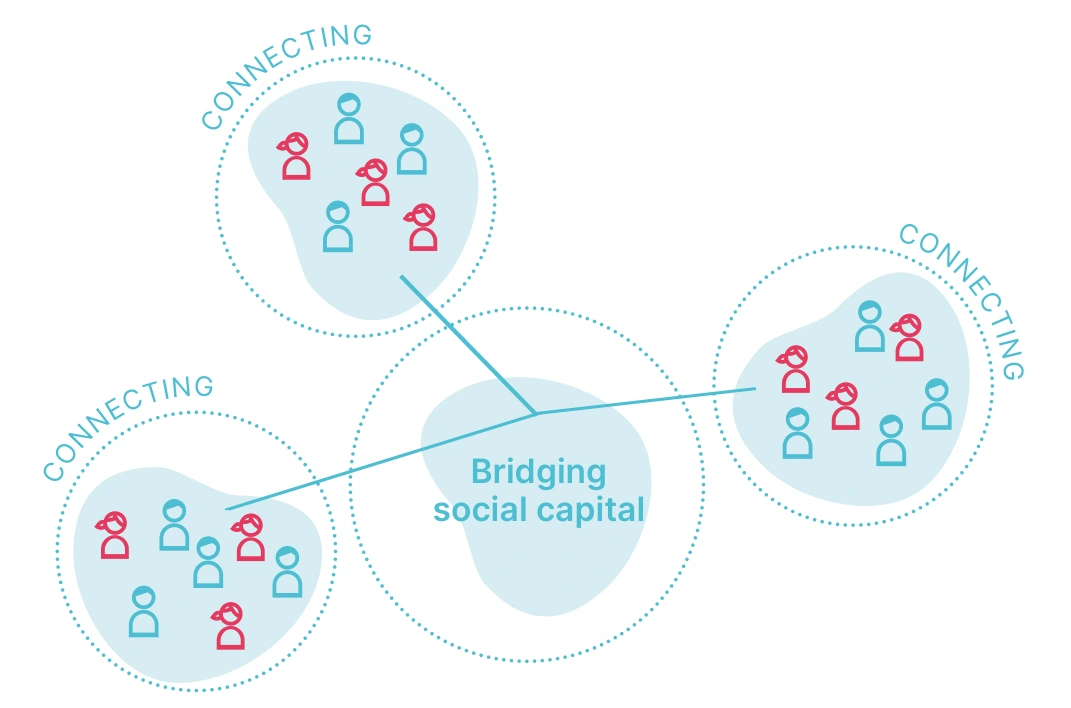
Not only does the neighborhood hold a wealth of bridging capital; its physical, social and civic context provides members with a unique twofold value.
- On the one hand, imagine the potential for vulnerable and less mobile people – older, isolated people in particular. For those who have no friends or family to lean on, the neighborhood may provide an important network of social relations and support. For those who are immobile, the neighborhood forms an indispensable part of their care network.
“The more numerous the threads within a social network, the smaller the mesh of the social safety net.”
- On the other hand, there is the unique common interest for various local themes. Think of the initiatives that local residents set up together in the physical space: from car sharing to litter picks. Some of these initiatives even go on to address worldwide challenges on a local level, such as the global plastics, litter and climate crisis.
- The relationship between the strength of the social fabric and both psychosocial and physical well-being has been well documented.8 In neighborhoods of the future, residents look after each other by offering social support and providing informal help. Vulnerable groups, too, learn that they can make valuable contributions to the community, allowing them to step out of their role as the ones in need of help. Older people live independently for longer, and the community actively fights social isolation.
- Various studies show a strong link between a sense of community and a feeling of security.9 In neighborhoods of the future, residents keep an eye on things, keep each other informed of any issues such as criminal activity, and call on each other when needed.
- The willingness of residents to work for the collective good of the neighborhood is more present in connected communities.10 In neighborhoods of the future, residents feel involved in both the community and local policy. They are more likely to take initiative, to volunteer and participate in projects run by neighbors, organizations and the government.
- In sustainable neighborhoods, residents will travel less often by car, because there is plenty to do in the local area and because sustainable travel is the norm.
- In sustainable neighborhoods, residents gladly exchange items, make group purchases and consume locally. Together, they get involved in developing and maintaining green spaces.
“Investing in local community building means investing in social issues such as mobility, environment, welfare, and citizen participation.”
1.3 Challenge
Disconnection
If today’s neighborhoods really hold so much value, why doesn’t it always feel that way? It seems as if we no longer judge the neighborhood by its potential to enrich our lives, but rather by its ability to accommodate our individuality. ‘They are quiet neighbors’, ‘we leave each other alone’ and ‘they come to water the plants when we travel’ seem to be the most desirable qualities of the modern neighbor.
Is this all we can expect? Is this what present-day life has done to us? Have our virtual friends on the other side of the planet and online clubs distracted us so much that we find it difficult to connect with our actual neighbors?
Tapping into the social capital of the neighborhood
The potential may be immense; that does not mean that the neighborhood’s value is there for the taking. Let alone that it is accessible for all members to the same extent.
Clichés such as ‘things were better in the old days’ are tempting to think, but they are most likely false and, at the very least, not constructive. What if we were to use the beautiful aspects of our current reality to connect more with each other? Then the neighborhoods of the future would become caring, connected communities that not only bridge our differences, but embrace and use them.
“The secret of caring neighborhoods of the future? Local community building, here and now.”
A formula for social capital
In this white paper, we propose a formula that provides insight into the dynamics of a neighborhood’s social capital. With it, we aim to help you both map and develop the local community’s value.

02 · A formula for the neighborhood
A formula for caring and sustainable neighborhoods.
So, the neighborhood has an undeniable value, in theory. Intuitively, however, we can often feel that one neighborhood offers its members more value than another. For example, there may be an area that is known as ‘arty’ or a town that has a good reputation for having a dynamic community due to social activism. Does that mean we can calculate the social capital of a specific neighborhood? And perhaps more interestingly: does that allow us to make some adjustments here, twist a button there, and set the neighborhood to a maximum social capital?
2.1 Social capital formula
On an individual level, a person’s social capital is usually described as the sum of resources that are available because of social relationships. Think of the drill you borrow from next door, the ride a friend offers you, the local tradesperson recommendation someone gives. Add it all up and there you have it: your social capital!
The collective level is more complicated when it comes to social capital, as the neighborhood’s social capital doesn’t simply equal the total resources of its residents. In our opinion, the formula for determining – or influencing – the social capital of a neighborhood consists of two elements: the potential of, and the access to, the neighborhood’s resources.

Complicated social concepts cannot be expressed in a simple formula, but a formula helps us navigate through the concepts of this white paper and, more importantly, it will inspire you to get started.
2.2 Potential
The neighborhood’s potential, or ‘urban surplus’, consists primarily of the sum of resources or assets in a local community. These take many forms:
- time
- talents
- finance
- material
- knowledge
- space
- connections
- emotional support
Demographics and socio-economic status largely determine the degree to which these assets are present. How many people live in the neighborhood? How diverse is its community? Is there vibrant local commerce?
Besides the assets in and of themselves, the extent to which the assets allow for collaboration, too, determines the potential of the social capital. The whole is greater than the sum of its parts. Diversity is an important factor for this connective potential.
In other words, the potential of a neighborhood consists of its citizens resources, plus the added value that arises from possible collaborations.
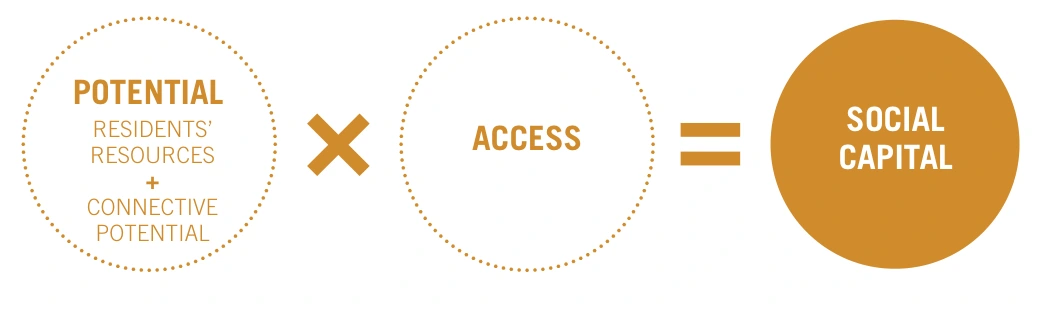
It can be extremely valuable to map these opportunities. By listing the main stakeholders in a neighborhood, it quickly becomes clear how collaborations can provide answers to a variety of challenges. At the end of this white paper, we’ll briefly talk about a method to carry out this analysis within the neighborhood, called ‘Neighborhood Capacity Mapping’.
2.3 Access
The fact that certain assets exist within the neighborhood does not mean that they can be used freely by the whole community. For this to happen, there must also be access to the assets.
This access is determined by the extent to which members can, and want to, connect to the community and its resources. Connecting refers to both supplying, managing, maintaining and using resources.
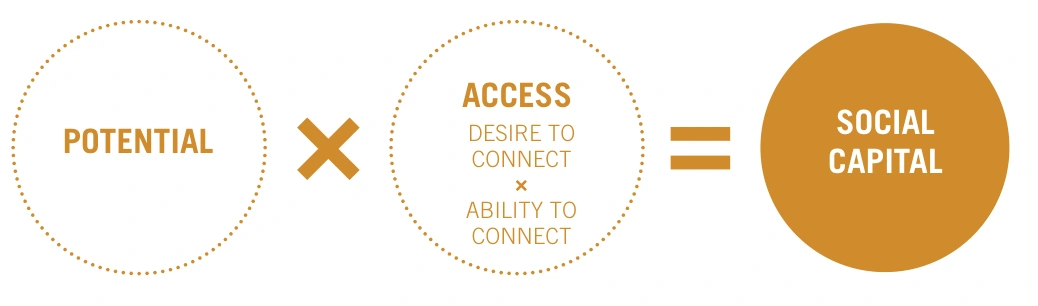
The ability to connect to the community and its assets is largely influenced by the spaces within the neighborhood, which either hinder or stimulate exchanges between neighbors.
The desire of local residents to connect to the community forms the last piece of the puzzle. We attribute this desire to the social cohesion of the neighborhood.
How strong are the ties between the local residents? What values and norms does the neighborhood uphold? How inclusive is the local community? These social dimensions greatly impact the access to the neighborhood’s social capital.
With the right tools, you can not only evaluate, but even influence this access. This, as far as we are concerned, is the definition of community building. And here lies the key to social capital.
“A neighborhood’s resources are what they are: an abundance of potential to enrich the neighborhood and its members. But the extent to which local residents can and want to make use of those resources… that’s where you can make a difference.“
03 · Wanting to connect
Social cohesion: wanting to connect.
The social cohesion within a neighborhood largely determines the extent to which residents want to connect to the network – and so the resources – of the neighborhood.
Social cohesion determines the extent to which residents are prepared to:
- share their own resources with the community
- turn to the neighborhood when needed
- work together to create a better neighborhood.
3.1 Defining social cohesion
We all agree that social cohesion is a good thing. It is a state that a group may or may not be in (to a varying degree), and if so, promotes the well-being of its members.11
Beyond that, it is a complex, layered and contested concept, and there is no single definition. So how do we evaluate the social cohesion of a neighborhood?
In our opinion, social cohesion is the result of numerous dimensions and their dynamics that determine to what extent members want to be part of the group.
Consequently, we can identify a few measurable dimensions of a neighborhood in order to best understand its social cohesion.
Think of it as the assessment of a person’s overall health. There is no ready-made test that puts a rating on a person’s health. But we can check blood pressure, body mass index or run blood works. In the same way, we can look at the local community from different angles to give an indication of its overall well-being, and then carry out an analysis.
Then we can outline a ‘treatment plan’. Using neighborhood initiatives (bottom-up) and interventions (top-down), we try to positively impact some of the relevant social dimensions, and so ultimately encourage people’s willingness to connect with their community.
3.2 Dimensions of social cohesion
Countless dimensions directly influence social cohesion. Some of them are measurable and under our influence, while others are not. Nearly every study uses a different set of social dimensions.
Based on the most common ones, as well as our own experience, we propose a shortlist of measurable and engineerable social dimensions as a guide. In our opinion, they offer a fairly complete picture of the social cohesion in any given neighborhood. At the very least, they offer a good starting point for an analysis and action plan, tackling:
- sense of community
- trust
- reciprocity
- shared values
- networks.
Below, we briefly discuss each of these dimensions: what do they mean for social cohesion in a neighborhood, and how could a local organization or government encourage them? As you will see, each dimension underlines the importance of positive exchanges between neighborhood residents.
3.2.1 Sense of community
Meaning
A sense of community includes the image that residents have of the neighborhood and the extent to which they identify with that image.12
It is all about the ‘we-feeling’ that may or may not be present in a neighborhood, comparable to that of a football club. Even though the supporters have not touched the ball during a match, they will gladly chant that ‘we won’.
If residents strongly identify with the neighborhood, they will find it important that the community is doing well. That’s because their identity and even pride are, to some extent, intertwined with it. Consequently, they are more likely to invest in the neighborhood.13
Community building by stimulating a sense of belonging
Residents get a stronger sense of community as they gain positive experiences, such as a fun local event or when a neighbor lends them a hand.14 Based on these experiences, people form a positive image of the neighborhood, in turn leading to a stronger sense of community.
They can even be vicarious experiences. Witnessing exchanges between other residents help shape our image of the community. Such as seeing two neighbors having a chat on the doorstep, reading how a local resident helped shovel snow for someone who’s housebound, or learning that the neighborhood organized a successful fundraising campaign for a local charity sometime before moving in.15
Local governments and organizations can stimulate a sense of community by providing a (more inclusive) platform for positive stories about the neighborhood.
Think, on the one hand, of public and virtual spaces where community members can meet for neighborly exchanges. We will talk about these spaces in chapter 4.
Also, you can share and promote inspiring testimonies (which may have emerged from a neighborhood analysis) using a local communication strategy.
- Annual community fete or music festivals
- Children’s and family activities
- LGBTQ+-specific events
- Religious festivals or interfaith events
- New Year’s Drinks or marking national public holidays
- Good neighbor awards
- Neighborhood Watch schemes
- Testimonials from residents
- Visits from local MPs or celebrities
- Street cafes for the homeless
- Buddy system for older people, those isolated or housebound
- Welcome event for new neighbors
- Solidarity or campaign actions
- Digital neighborhood network
- Taking part in national environmental initiatives, e.g., Fridays for Future school strikes
- Neighborhood slogan.
3.2.2 Trust
Meaning
Trust refers to the expectation that neighbors will behave beneficially, or at least not harmful, to each other and the wider community. Without mutual trust, members are reluctant to cooperate, which is detrimental to the neighborhood’s social capital.16
Trust comes with an element of risk: ‘Despite the possibility that my neighbor will never return my ladder, I will lend it to them anyway’.
Trust plays a role at different levels that are important for social cohesion in a neighborhood:
- trust in an individual
- trust in a group we identify with
- trust in a group we do not identify with
- trust in an institution.
Community building by stimulating trust
If there is systematic mistrust in a neighborhood, it is usually either a result of bad personal experiences or low perceived safety in areas with high crime rates.
- Roles. Role ambiguity means that it’s not clear what someone can expect from another person, and what protocols are attached to an exchange. That is why it can be worthwhile to appoint a contact person in the neighborhood, such as a buddy or neighborhood ambassador.
- Transparency. Say what you’ll do and do as you say. Communicating in a timely, clear and consistent manner, and then acting on it, can help to restore trust at a local level.
- Environment. Research shows a link between the state and satisfaction of facilities in the neighborhood on the one hand, and social trust on the other.17 Consider the impact of degradation such as fly-tipping and litter, vandalism or broken street lights on feelings of safety and trust. The maintenance of a public space is important to boost trust and a love of the neighborhood. Organizations like Keep Britain Tidy have many campaigns which focus on encouraging residents to practically demonstrate a love for their area.18
- Meetings. Mistrust often stems from fear of the unknown. Opportunities for neighbors to meet can foster positive experiences, trust and a sense of invested belonging. Therefore, encounters with attention to diversity become all the more critical: meetings between young and old, between newcomers and established households, and between different ethnic minority or faith groups.
- Give trust. A local government can change the narrative around a group or organization by enabling them to make a positive impact on the neighborhood. For example, you could ask the neighborhood’s young people to think up an action against litter.
3.2.3 Reciprocity
Meaning
Most favors – be it lending a ladder or sharing some information – are expected to be returned sooner or later. This pattern of expectations is called reciprocity. Reciprocity occurs in various forms, depending on the nature of a relationship or network.19
A. Negotiated exchange
Firstly, the norm ‘negotiated exchange’ can apply. In this case, both parties involved will agree on the terms in advance. Who will do what and what is expected in return. The exchange takes place bilaterally, more or less at the same time.
Negotiated exchanges often take place in cases of little trust. The chances of success for the neighbor in need of help depend greatly on their own actions, and therefore, capacities. Moreover, these exchanges rarely lend themselves to repetition or relationship development.
B. Reciprocal exchange
A neighbor could also share their resources without expecting anything in return. They do not know if the favor will be returned. This is called a ‘reciprocal exchange’.
In this case, the exchanges are separate, unilateral, and form a healthy base for a long-term relationship.
If the favor is never returned – especially when a clear opportunity arises – this may damage the reputation of the one who was at the receiving end of the former exchange, and the relationship between the two. In other words, there is still a certain expectation.
C. Generalized exchange
A third possibility is a generalized exchange, in which a neighbor does not necessarily give something in return to the person who helped them, but to another neighbor.
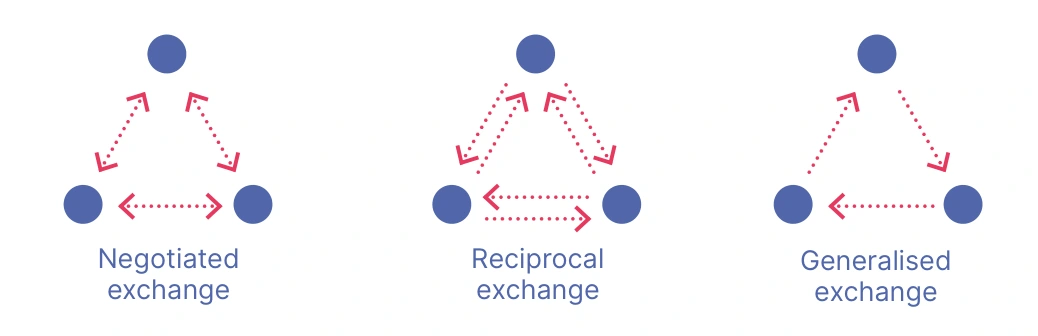
In this type of ‘indirect’ exchange, local residents do not depend on one another, but on all members who contribute to the network.
This form of reciprocity brings important benefits to the neighborhood. For example, exchanges can also manifest themselves in actions of neighborly behavior. In a neighborhood where generalized exchanges are the norm, residents might pick up litter from each other’s drive without giving it a second thought. Or they may automatically keep an eye out for one another.
In addition, there is an important advantage for residents who have broad resources to offer (for example, sewing skills). They are more likely to be able to help people across the entire neighborhood, rather than one specific neighbor. Vulnerable residents can also step out of their role as the ones in need of help by thinking about what it is they can give to others in terms of time, energy or skills. Truly, we believe everyone has something to offer the neighborhood.
The degree and form in which reciprocity is present determine the extent to which residents are willing to contribute or dare to ask for help.
Community building through reciprocity
It is difficult to set up a structure of generalized exchanges without strong social cohesion. However, a local government or not-for-profit organization can help to increase the motivation to exchange resources.
Making exchanges visible within the neighborhood plays an important role, for three reasons:
It makes it clear that it is the community’s norm to help neighbors without expecting a favor in return.
- The neighborhood’s help requests are shared with everyone, which increases the chance that someone will see something they can help with.
- If our helpful actions are visible to the community, that is very positive for our reputation, which can be an exceptionally strong motivator.
- A digital neighborhood network allows local residents to make their help requests and offers visible for a long time. Reactions and exchanges are accessible to all members.
- A neighborhood library or tool shed are physical evidence of valuable exchanges in the local community.
- A neighborhood communication campaign highlights particularly special or unique exchanges. Think of neighborhood projects such as good-neighbor awards or press stories about the area.
3.2.4 Shared values
Meaning
Values are abstract and emotional beliefs that exist along a continuum and drive specific attitudes and behaviors.20
Put more simply, there are many values to which people attach varying degrees of importance. Integrity, productivity, respect, success, dedication, equality… These translate into norms – rules of conduct – that dictate the appropriate action in a given situation.
Our norms and values determine not only our behavior, but also how we evaluate the behavior, and ultimately the character, of others. If a neighbor’s behavior goes against our norms and values, that may negatively impact our opinion of them.
A sense of shared values has a major impact on a dimension we discussed earlier: trust. If we expect someone to share the same values, we are more likely to trust that we are working towards a common goal, while respecting the same rules.
Community building by emphasizing shared values
A mismatch of values is a major cause of friction between groups, such as different cultures and generations. Conflicting values can divide a community. On the other hand, shared values have the potential to bring people together.
Every two parties in a neighborhood certainly have one shared value. It is important to emphasise them.
- Using a neighborhood survey, find out which norms and values stakeholders of the neighborhood (residents, organizations, etc.) hold dear, at personal, social and neighborhood level.
- Look for shared values that are as inclusive as possible. Think of values such as respect, helpfulness and tolerance.
- Translate the shared values of the neighborhood into some kind of neighborhood manifesto. Think of a slogan or a set of commandments.
- Make the shared values visible in the neighborhood. Either physically in the neighborhood (e.g., a poster) or via a folder or website. This way, newcomers immediately know what the neighborhood stands for.
- As an optional final step, connect various parties around the shared social values to increase social cohesion. Connect youth and a local non-for-profit organization around the environment, or couples from different ethnic-cultural backgrounds around work or parenting.
3.2.5 Network
The four dimensions we have mentioned (sense of belonging, trust, reciprocity and shared values) are cognitive, they exist mainly in the minds of residents and are highly subjective. Network, on the other hand, is a structural dimension that tells us something about the composition of the neighborhood. It is more or less objective.
If we could visually map all residents and organizations in the neighborhood, we could draw lines between any two parties where a relationship exists. These lines would tell us how well individuals and organizations are networked within the neighborhood.
Clusters of homogeneous groups would likely emerge, with perhaps rather sparse (horizontal) bridges between them. These refer back to the bonding and bridging social capital we talked about at the beginning of this paper.
In addition, we would notice some (vertical) links between groups and organizations, which are contained in the linking social capital.
The better an individual or organization is networked within the neighborhood, the more likely someone will be to join the overall neighborhood network, which also includes strangers.
Moreover, the stronger the neighborhood network is today, the more appealing it will be for an individual or organization to join it.
Community building through the expansion of existing networks
By stimulating new relationships between individuals, groups, and organizations in the neighborhood, parties become better networked and social cohesion increases. In this way, more and more people feel willing to contribute to the local community.
- Bridge figures. They can play an important role by bringing different parties into contact with each other. Think of community workers, buddies, or the Neighborhood Concierge.21
- Meetings. Organize welcome events or other networking opportunities where local residents can meet each other.
- Actions. Activities on themes that citizens care about offer an ideal environment for relationships to develop. Think of a drop-in service for new mums or an information session on the climate crisis.
- Physical and virtual spaces. Quality, accessible spaces both offline (such as a park or indoor hall) and online (such as a digital community group on social media) are needed for spontaneous exchanges to occur.
- Advertise organizations. By publicising local organizations, relationships between organizations and citizens, and between organizations themselves, can be established more quickly. Think of a directory of local traders or an open day where business owners showcase their skills and services.
04 · Being able to connect
Creating space to connect.

Quick reminder Do you recall the two elements that determine access to social capital?
So far, we have looked at the desire to connect, which is largely determined by social cohesion. Now we will look at the ability, the extent to which we can connect to the resources of the neighborhood.
Communication infrastructure
A neighborhood’s communication infrastructure includes the physical and virtual spaces within which local residents interact.
To a large extent, it is the quality of this communication infrastructure that determines whether the neighborhood is able to:
- share their own resources with the community
- turn to the neighborhood when needed
- work together to create a better neighborhood.
The importance of spaces
Without the presence of quality, accessible spaces where residents can systematically come into contact, it is difficult to make use of the social capital of the neighborhood.
For without physical or virtual spaces, how could we:
- know who lives nearby
- know what resources are available in the neighborhood
- ask for help
- provide help
- talk about challenges and solutions
- join hands?
Role of a government
Often, providing a space where neighbors can come into contact, amounts to an investment of time, money and energy. In this respect, the role of a local government is threefold:
- understanding the needs of the neighborhood
- providing the required spaces
- maintaining the existing spaces.
Getting local residents involved in these processes is beneficial for the end result, the engagement in the project and the social cohesion in the neighborhood.
4.1 Physical spaces
Third places
With physical spaces, we mean all places in the neighborhood that offer members the opportunity to interact with each other (such as a footpath), but even more so the places that stimulate interaction. Think of a local café, community center or park.
Ray Oldenburg talks about third places.22 Where your home serves as first place and your work environment as second place, third places are:
- accessible to all
- aimed at informal conversations in a comfortable setting
- familiar, perhaps because there are often familiar faces
- a non-compulsory stop – visitors are there because they want to be.
Third places are important for the social life of the neighborhood. They offer residents the opportunity to discuss community issues, exchange opinions, learn from each other etc., which can lead to relationships and actions.
Parochial room
Over time, neighbors can parochialise these places.23 The parochial space is a layer between the private and public space.
Within the parochial space, people behave slightly differently towards each other. These exchanges do not have the intimate character of a friendly relationship, but neither do they have the detachment that exists between strangers. The parochial space invites friendly recognition, light-hearted conversation and other expressions of neighborliness.
Subjective experience
Whether a space is public or parochial, depends on the viewer. A customer of a local café who does not live in the neighborhood will see the café as a public space and will behave neutrally. A local resident might be more inclined to approach other customers and strike up a conversation.
The meaning that a space carries also varies among residents. The physical neighborhood can be divided into concentric circles around someone’s home.24 The closer a place is, the more meaning it carries. For example, just by looking out the window, a person could learn a lot about their immediate neighbors.
A community bench can be worth a lot to someone who lives right around the corner, but not so much to a resident from the other side of town. Strategic placement of such meeting places can therefore be of great value.
Finally, the history and associations attached to a place are important.25 A park where many pleasant neighborhood activities have taken place in the past will be well loved and cherished. One that is associated with frequent nuisance will gain a bad reputation. For this reason, the usage and maintenance of a place are of great importance.
4.2 Virtual spaces
The meaning of virtual space
Every space that allows exchanges between residents provides access to social capital to a certain extent. Besides physical meeting places, it could also be a noticeboard or a digital neighborhood network such as Hoplr.
Virtual spaces provide insight into the identity, resources, and challenges of the neighborhood. Like physical spaces, they allow residents to ask and answer questions, exchange information and form collaborations.26
Persistence, replicability, scalability, and searchability
Virtual exchanges are usually less suitable for forging strong ties. In the context of community building, on the other hand, they do have some valuable features.
Online exchanges (such as neighborhood messages on Hoplr) are registered and saved, allowing them to be accessed and shared by other neighbors, now and in the future.
In other words, the exchanges that take place online have a great potential to make an impact on residents who were not directly involved in the initial interaction.
This, in turn, has an exponential effect on:
- the development of neighborhood identity27
- the likelihood of members crossing paths with relevant resources (e.g., an invitation to a community activity, information, help, etc.)
- observational learning (gradually learning the norms of the neighborhood, and finding it easier to ask for help).
Moreover, some local residents might find neighborhood contact within the virtual space more accessible than the physical space.

05 · Neighborhood dynamics
Social cohesion and spaces reinforce each other.
In chapter two of this white paper, we proposed a formula, which we have elaborated on in the previous chapters. We used this formula as a guideline to talk about the social capital of a neighborhood.

Of course, social capital is not so black and white. Numerous factors impact people’s desire and ability to connect with the community. Many of these factors are beyond our control. We call them preconditions. We will discuss these further on.
Moreover, social cohesion and spaces in a neighborhood are anything but separate. We’ll call them the ‘yin and yang of the neighborhood’.
We’ll conclude that the dynamics of a neighborhood are innumerable, which is good news – offering ingredients that potentially have an exponential effect on access to the neighborhood’s resources. This brings countless opportunities to increase the social capital of the local community.
5.1 The influence of spaces on social cohesion
The spaces of a neighborhood shape its social cohesion.
- In a clean neighborhood, where vandalism or litter is rare, the feeling of trust and belonging may be greater.
- Neighborhood art, statues or other recognizable symbols are part of the image of the neighborhood and help to form a shared identity.
- The presence of local shops and trade facilities makes it easier to forge neighborly relations.
- A virtual space where neighbors can discuss community-related topics makes it easier to see what values neighbors hold dear.
5.2 The influence of social cohesion on spaces
The opposite is equally true. Social cohesion will be reflected in the spaces of a neighborhood.
- A neighborhood with a strong sense of community will gladly support the local economy.
- In a neighborhood where residents trust one another, citizen initiatives are more likely to pop up.
- A local community that can vocalise its shared appreciation for a clean neighborhood, is more likely to help take care of its physical spaces.
- In a neighborhood with a strong sense of reciprocity, the use and success of a digital neighborhood network will be greater.
5.3 Preconditions
The communication environment of the neighborhood includes the intangible factors, or preconditions, to which the spaces, relationships, and exchanges within the neighborhood are subjected. This environment can be favorable or unfavorable, and influences different groups in different ways.
We distinguish six types of preconditions that determine the communication environment:28
The role of a local government
The communication environment and its preconditions are fairly consistent within a neighborhood. Therefore, it is difficult to make an immediate impact as a government or organization.
However, it is important to be aware of these preconditions and to take them into account, for example, in the development of initiatives.
It is valuable to include these preconditions in a neighborhood analysis. It is then possible to evaluate whether certain actions relating to the communication environment are possible and appropriate.

06 · Conclusion
The neighborhood as a starting point.
The neighborhood holds an enormous value for all residents, which can be summarized as social capital. This value extends to the whole of society, within themes such as safety, mobility and care bringing to life phrases like ‘think global, act local’.
However, this social capital does not seem to be equally present in every local community. Governments are becoming aware of the potential of the local level and are asking themselves how they can stimulate engagement in the neighborhood. In this white paper, we put forward a formula.
It is not easy for a local government to make an impact on the potential, the resources of a neighborhood. However, we believe that all the tools needed to tackle a challenge are already present in every neighborhood.
A local government or organization can make a significant impact on the access to the community and its resources. This is what we refer to as community building. It’s all about stimulating the extent to which residents can and want to connect to the neighborhood network.
We linked the desire to engage in the community with social cohesion. Social cohesion is made up of a whole range of social dimensions that a local government or organization can stimulate to varying degrees.
We linked the ability to tap into the neighborhood’s resources to the spaces where neighbors can interact. Government should focus on places and channels that encourage encounters and exchanges.
The role of local government is to act as a facilitator in a well thought out and inspired way, and, therefore, to invest in community building.
This is done, firstly by mapping the neighborhood’s challenges and opportunities, and then creating neighborhood projects and spaces that enable and entice residents to connect to the neighborhood network.
Hoplr wants to do its bit as a digital neighborhood network and knowledge center for communities. We are currently working on the Neighborhood Score, which uses an automatic neighborhood scan to reveal various dimensions of a neighborhood year after year, based on the formula we have discussed in this paper. This score will serve as guidance to develop and evaluate any neighborhood interventions and give a strong sense of direction.
The Neighborhood Score will serve as a layer on top of our existing digital neighborhood networks, where hundreds of thousands of neighbors are already exchanging information, help and items.
In addition, we are in the process of launching our Neighborhood Concierge, which combines the familiarity of a friendly face, with the efficiency of a digital dashboard that matches supply and demand.
07 · Getting started
From neighborhood analysis to action.
Investing in the social capital of a neighborhood ideally runs in two phases: measuring (neighborhood analysis) and stimulating (neighborhood project).
- First, it pays to investigate the peculiarities of a neighborhood, by listening to its residents. This way, you’ll learn which interventions are expected to have the greatest potential impact.
- Then comes the time for action. Based on the challenges you’ll have identified, you aim to develop one or more projects that will make the greatest impact on the local community.
7.1 Neighborhood analysis
The challenges and opportunities of a neighborhood are mapped by means of a neighborhood analysis. We base this analysis on three components:
- the resources of the neighborhood (potential)
- some social dimensions within the neighborhood (access)
- neighborhood spaces (access)
You may have a pretty good sense of how a neighborhood is doing already. But you’ll want to avoid drawing conclusions based on gut feelings alone. At least because you most likely do not identify with some socio-demographic groups in the neighborhood.
Therefore, we look for both quantitative and qualitative data, at least partly with the local residents. Next, we briefly discuss the four most important methods of collecting data.
7.1.1 Methods
Consultation of available existing data
The county councils probably have a lot of useful information to hand. For example:
- socio-demographic data
- data on local trade, local organizations
- results from previous studies
- other available information such as a neighborhood map, unemployment figures, number of community initiatives, number of visitors of neighborhood events.
Survey
A lot of anonymous quantitative data can be collected relatively easily by means of an online, paper and/or telephone questionnaire.
The biggest challenge in creating a survey is to choose your questions wisely. The questions must gather the necessary information and be accessible and digestible.
Interviews
Interviews will likely give you limited data on a few topics, but on the other hand, they allow you to collect in-depth, qualitative data. Therefore, it is a good way to gather subjective and anecdotal information that can’t be expressed in numbers.
It is advisable to do your interviews with some key figures in the community. These are people who know a lot about the neighborhood, or who can represent a certain group within the area.
Focus group discussion
In a group discussion, local residents are invited to enter into dialogue together. This can take the form of a workshop, focus group, neighborhood panel, neighborhood walk, etc.
Neighbors share ideas and are inspired by each other during these events. That is the strength of a group discussion. There is ample room for talking through challenges and solutions, which are nuanced by different voices from the community.
Combination
Each of the above methods brings specific advantages and challenges. This is precisely why it is so valuable to provide a combination of methods:
- A neighborhood analysis usually starts with a preliminary investigation.
- Followed by a phase with a survey and interviews.
- Finally, the results are an excellent basis for a group discussion.
7.1.2 Developing a neighborhood analysis
Following the chosen methods, you will need questions. Questions you include in your survey or interview, but also research questions on topics that you want to know about. Below we share some inspiration for both.
Composition of the neighborhood
Official administrative data can already provide a lot of insight into the composition of a neighborhood. Such a consultation is indispensable to carry out a sample and to optimise representativeness.
For this reason, too, it is essential to include some socio-demographic questions in other methods.
- What gender do you identify as?
- What is your age?
- What is your marital status?
- How long have you lived in this neighborhood?
- Were you born in this country?
- Were your parents born in this country?
- What is your first language?
- What language do you speak most at home?
Diversity
It is mainly during spoken conversation – either one on one or in a group – that local residents give meaning to the composition of the neighborhood, for example, the diversity.
- “People of different origins live well together in the neighborhood”
- “People from different generations live well together in the neighborhood”
- “Newcomers and long-time residents live well together in the neighborhood”
- “Diversity enriches this neighborhood”
Sense of community
Community feeling can vary greatly within the same neighborhood. Research shows that young families, residents who spend a lot of time close to home, and people who have lived in the neighborhood for a long time, experience a stronger sense of community. Young people and residents facing a language barrier tend to experience a lower sense of community.
Because community feeling is very subjective, it is important to collect a range of opinions, with special attention to the particular groups.
- “If someone takes the initiative to organize something in the neighborhood, I still feel that ‘we’ are organizing something, rather than ‘they’ are organizing it
- “I feel connected to the neighborhood”
- “I hope to live in this neighborhood for a long time”
- “It is important to me that my neighbors think I am a good neighbor”
- “If there is a problem in the neighborhood, the residents are likely to deal with it effectively”
Trust
Research shows an inverse relationship between trust and diversity. Trust will not only be experienced differently by people, but also shown towards different communities in the neighborhood.
We must avoid targeting any communities. In other words, we’ll aim to keep the questions as general as possible.
- “I would feel unsafe walking alone in the neighborhood after sunset
- “If I were to lose my wallet in the area, there is a good chance that I would get it back with its original contents”
- “I would be willing to lend the chairs that are in my dining room for a neighborhood’s party”
- “I trust that the local government has my best interests at heart”
- “If I were looking after my own or someone else’s child and there was an emergency, I would trust my neighbors to look after the child”
Reciprocity
Knowing whether a network of generalized exchanges is present in a neighborhood provides a valuable indication of the ease with which residents connect to the social capital.
Since reciprocity is partly related to a person’s reputation in the neighborhood, these questions are better asked anonymously.
- “If a neighbor helped me with computer problems, I would probably pay them”
- “Most residents of this area help each other without having to be asked”
- “If I were to lend a drill to a neighbor, I would expect something in return”
- “When I see litter on the street in our neighborhood, I put it in the bin, even if it is not mine”
- Have you helped a neighbor for free in the past year?
Shared values
You may want to find out whether local residents today feel that they share values with their neighbors. The best way to ask this is through an anonymous survey.
It can also be useful to find out which exact norms and values community members might share. An anonymous survey can list a few and residents can then indicate their importance.
A group discussion might be interesting to create such a shortlist.
- To what extent do you think it is important that local residents help each other spontaneously?
- To what extent do you think it is important that local residents do not gossip about each other?
- To what extent do you think it is important to others in the community that the area is quiet after 10pm?
- To what extent do you think it is important for others in the neighborhood to maintain their front garden and driveway?
Network
We get a better picture of the networks in a community by enquiring about them in an anonymous survey, but also by entering into dialogue with the most important groups and organizations in the neighborhood.
- How many of your neighbors can you turn to for a chat?
- How many of your neighbors can you turn to for help?
- How many of the neighbors you can turn to for conversation or help would you describe as ‘from another generation’?
- How many of the neighbors you can turn to for conversation or help would you describe as ‘from another culture or nationality?’
- How many organizations or businesses in the neighborhood have you called upon in the past?
Spaces
The need for more meeting places in the neighborhood and the way they are used, can easily be questioned through an anonymous survey.
Which places already fulfil a meeting function today may be too broad a question and require some nuance. We think it’s better discussed within interviews or through a focus group.
- Do you think there are enough meeting places in the neighborhood?
- Do you think the public spaces in your neighborhood are well maintained?
- Where do you most often come into contact with local residents today?
- If you needed help, how would you get in touch with your neighbors?
- Which places in the neighborhood encourage residents to chat and interact?
- Which places have an important meaning to you in your neighborhood?
Resources
A survey can be used to map the resources that local residents are prepared to share with their neighbors.
What organizations and groups are present and how they can help the neighborhood are topics better mapped out by entering into a dialogue.
- What kind of help could you offer?
- Do you have any talents that could be useful for the community?
- How much time could you spare to help a neighbor or the community?
- Do you have a lot of knowledge about a topic that could benefit the neighborhood?
7.1.3 Visualizing input
To map the input of residents in a meaningful way, it is best to use a suitable frame of reference. Below, we share two methods. These can be completed or evaluated in cooperation with residents.
Neighborhood Capacity Mapping
The diagram below is often used in Asset-Based Community Development (ABCD), an approach to sustainable community-driven development. It tries to visually represent all local institutions, voluntary organizations and groups. A walk through the neighborhood is very suitable for this purpose.
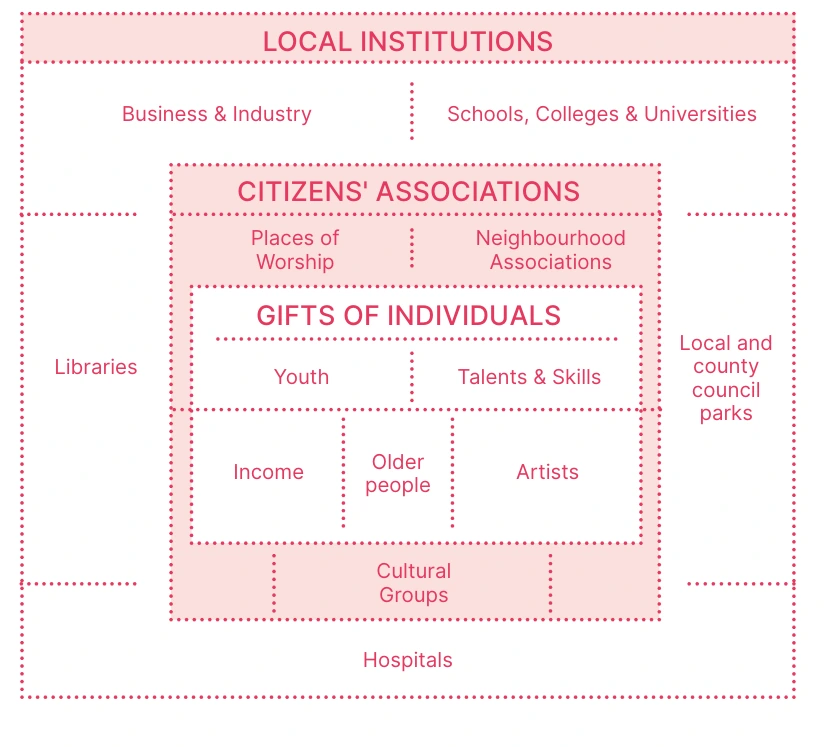
Then, for each party or group, we fill in which valuable resources (such as spaces, knowledge and helping hands) they can offer to move the neighborhood forward. This way, it becomes visually clear which partnerships have the potential to tackle neighborhood challenges.
Do not shy away from including groups of people or institutions around which tensions may exist. Everyone has something to offer the neighborhood. Fruitful cooperation also gives such parties the opportunity to present themselves more positively.
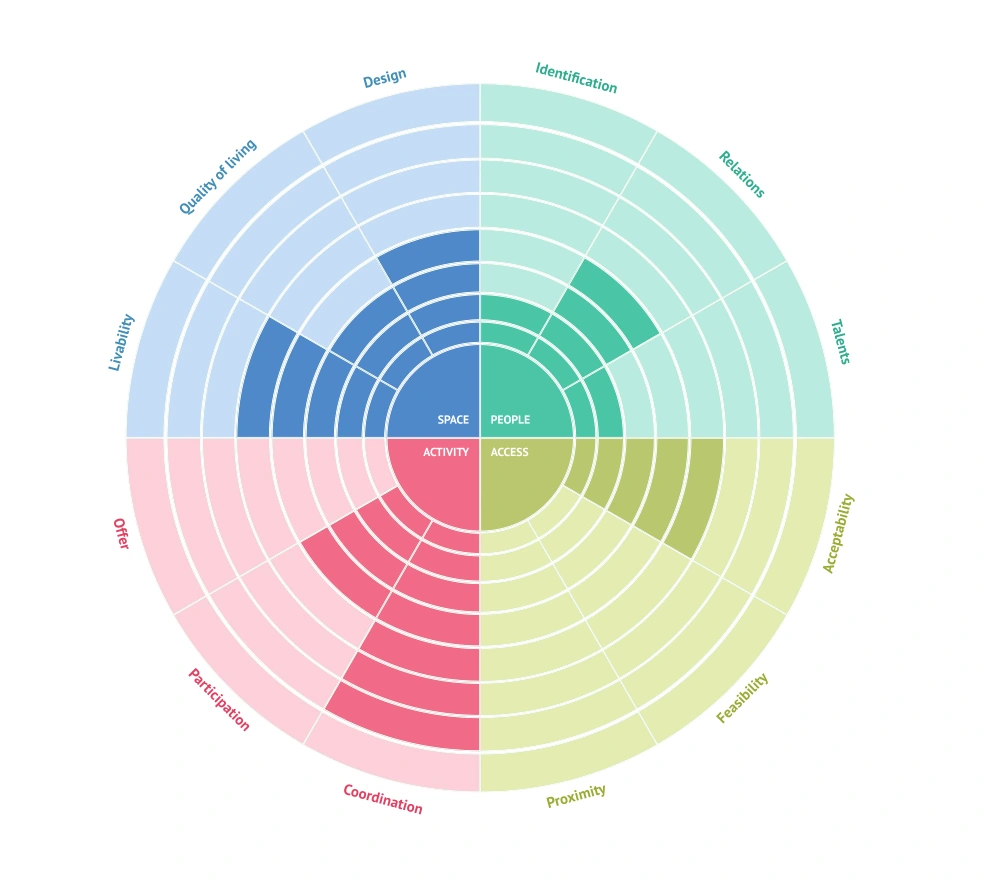
Neighborhood lens
The degree to which residents appreciate their neighborhood can be reflected in the neighborhood lens. The neighborhood lens consists of four domains, namely spaces, people, access and activities. Each of these comprises another three subdomains.
You can fill in the neighborhood lens yourself based on data from a survey and/or interviews, and then have the scores evaluated within a group discussion. Alternatively, you can fill in the puzzle together with those present at a workshop.
The neighborhood lens is an excellent starting point for a dialogue about the neighborhood. It makes it easier to see in which main and subdomains there is the most need for improvement.
7.2 Neighborhood projects
Next, we will translate the challenges and opportunities of a neighborhood into one or more community projects. We want to increase access to social capital by:
- strengthening social cohesion in the neighborhood
- optimising the spaces of the neighborhood.
As much as possible, we want to enable the residents to deal with the challenges. This is in line with Asset Based Community Development.
What does a neighborhood project look like? That depends on a number of things:
- What challenges did the neighborhood analysis reveal?
- What do the authorities or local residents want to work on as a priority?
- What is needed to improve the situation?
- What can local residents do?
- Which institutions, organizations and groups want to get involved in the project?
- What support, if any, do local residents need from the authorities?
7.2.1 Inventory
To conclude, we share below a far from complete inventory of possible neighborhood projects or interventions, small or large, with varying degrees of involvement from the local government.
Digital neighborhood network
Online network where neighbors are in contact with each other to exchange help requests and resources. Example: Hoplr, WhatsApp, Facebook group…
Events
Different parties from the neighborhood come together in an organized setting. Example: new year’s drinks, welcome event for new residents, pop-up cinema, car boot sale, local open business day…
Grants
The local government offers financial compensation for actions that benefit the social fabric of the neighborhood. Example: neighborhood budget, subsidy for a neighborhood party, reimbursement for street decorations...
Identity of the neighborhood
Determining together what the neighborhood stands for and communicating this in an accessible way. Example: neighborhood logo, slogan, manifesto, artwork...
Macro-communication
Neighborhood communication from the local council or other relevant institutions. Example: communication about ongoing roadworks or maintenance which is likely to cause inconvenience or noise disturbance, neighborhood news, raising awareness of area-related topics, announcing upcoming activities, neighborhood participation, dialogue…
Neighborhood initiatives
Neighborhood residents devise and implement a project, with or without limited support from the local council. Example: neighborhood litter pick, community allotments, neighborhood library, dance lessons for seniors, neighborhood barbecue…
Network of key figures and intermediaries
Database with contact details of people through which you can reach diverse or minority groups (mainly vulnerable or otherwise hard to reach). Example: care providers, community workers, police community support officers, associations, local traders, religious communities…
Participation project
The government offers residents a say in the form of feedback, advice, opinions, ideas or action. Example: feedback on playground redesign plans, citizen budget, neighborhood agenda, anti-litter and fly-tipping campaigns, collecting ideas on community building….
Physical space
The local authority carries out an intervention in the space of the neighborhood or allows others to do so. Example: a new park, playground redesign, neighborhood benches, work of art, noticeboard, school opening up the playground to the neighborhood...
Social project
The local authority invites residents to join them in a project aimed at inclusion within or outside the neighborhood. Example: buddy work, volunteer work, fundraising, solidarity actions...
08 · Sources & credits
The people behind this whitepaper
The following references are included in the original whitepaper.
- Catch 22 and Nominet, Digital disadvantage – barriers to digital skills and access, 2021.
- Statistica, Feeling of loneliness among adults 2021, by country, 2021.
- R. Forrest, A. Kearns, Social cohesion, social capital and the neighbourhood. Urban Stud. 38, 2125-2143 (2001); D. Schiefer, J. van der Noll, The essentials of social cohesion: a literature review. Soc Indic Res. 132, 579-603 (2017).
- H. Rainie, B. Wellman, Networked: the new social operating system (MIT Press, Cambridge, Mass, 2012).
- K. N. Hampton, B. Wellman, Lost and saved . . . again: the moral panic about the loss of community takes hold of social media. Contemporary Sociology: A Journal of Reviews. 47, 643-651 (2018).
- J. S. Coleman, Social capital in the creation of human capital. American Journal of Sociology. 94, 95-120 (1988);N. Lin, Social Capital: A theory of social structure and action (Cambridge university press, 2004).
- R. S. Burt, Brokerage and closure: an introduction to social capital (Oxford University Press, Oxford; New York, 2005).
- P. A. Thoits, Mechanisms linking social ties and support to physical and mental health. Journal of Health and Social Behavior. 52, 145-161 (2011);A. M. Ziersch, F. E. Baum, C. MacDougall, C. Putland, Neighbourhood life and social capital: the implications for health. Social Science & Medicine. 60, 71-86 (2005).
- C. M. Fourie, in Collaboration, Communities and Competition: International Perspectives from the Academy, S. Dent, L. Lane, T. Strike, Eds. (SensePublishers, Rotterdam, 2017) J. D. Lichterman, A “community as resource” strategy for disaster response. Public Health Rep. 115, 262-265 (2000);R. J. Sampson, S. W. Raudenbush, F. Earls, Neighborhoods and violent crime: a multilevel study of collective efficacy. Science. 277, 918-924 (1997);C. van Eijk, T. Steen, Why citizens want to be co-producers, 10 (2013).
- A. L. Kavanaugh, D. D. Reese, J. M. Carroll, M. B. Rosson, Weak ties in networked communities. The Information Society. 21, 119-131 (2005);Y.-C. Kim, S. J. Ball-Rokeach, Civic engagement from a communication infrastructure perspective. Communication Theory. 16, 173-197 (2006);J. M. McLeod, D. A. Scheufele, P. Moy, Community, communication, and participation: the role of mass media and interpersonal discussion in local political participation. Political Communication. 16, 315-336 (1999);C. Talò, T. Mannarini, A. Rochira, Sense of community and community participation: a meta-analytic review. Soc Indic Res. 117, 1-28 (2014).
- D. Schiefer, J. van der Noll, The essentials of social cohesion: a literature review. Soc Indic Res. 132, 579-603 (2017).
- D. W. McMillan, D. M. Chavis, Sense of community: a definition and theory. Journal of Community Psychology. 14, 6-23 (1986).
- L. Mahmoudi Farahani, The value of the sense of community and neighbouring. Housing, Theory & Society. 33, 357-376 (2016).
- E. J. Lawler, S. R. Thye, J. Yoon, Social commitments in a depersonalized world (Russell Sage Foundation, New York, 2009).
- J. D. De Meulenaere, B. Baccarne, C. Courtois, K. Ponnet, Neighborhood hotspot and community awareness: the double role of social network sites in local communities. Communications. 1 (2020), doi:10.1515/commun-2019-0135.
- R. S. Burt, Brokerage and closure: an introduction to social capital (Oxford University Press, New York, 2005).
- N. Hassan, T. S. Y. Lim, The quality of neighbourhood facilities and their effect on social trust in Salak Selatan new village, Kuala Lumpur. Journal of Regional and City Planning. 31, 264-284 (2020).
- Keep Britain Tidy, Support our campaigns, 2022.
- L. D. Molm, The structure of reciprocity. Social Psychology Quarterly. 73, 119-131 (2010).
- L. Wray-Lake, B. D. Christens, C. A. Flanagan, in Encyclopedia of quality of life and well-being research, A. C. Michalos, ed. (Springer Netherlands, Dordrecht, 2014), pp. 1102-1107.
- A service offered by Hoplr where people in the neighbourhood, mainly older people, can call a neighbourhood concierge and ask them for someone to help mow their lawn, for example. The concierge would know a lot about the community, who’s free to volunteer and which professionals or companies are trustworthy – so they would find someone suitable to help.
- R. Oldenburg, The great good place: cafés, coffee shops, bookstores, bars, hair salons, and other hangouts at the heart of a community (Marlowe , New York, 1999).
- M. Kusenbach, Patterns of Neighboring: Practicing community in the parochial realm. Symbolic Interaction. 29, 279-306 (2006);L. H. Lofland, The public realm: exploring the city’s quintessential social territory (Aldine de Gruyter, Hawthorne, N.Y, 1998), Communication and social order.
- M. Kusenbach, A hierarchy of urban communities: observations on the nested character of place. City & Community. 7, 225-249 (2008).
- T. Mannarini, A. Rochira, C. Talò, How identification processes and inter-community relationships affect sense of community. Journal of Community Psychology. 40, 951-967 (2012);Y.-F. Tuan, Space and place: the perspective of experience (Arnold, London, 1977).
- J. De Meulenaere, C. Courtois, K. Ponnet, in Routledge companion to local news and journalism, A. Gulyas, D. Baines, Eds. (Routledge, Oxford, UK, 2020), pp. 398-407;C. López, R. Farzan, in Proceedings of the 7th international conference on communities and technologies (ACM, New York, NY, 2015), C&T ‘15, pp. 59-67.
- De Meulenaere, J. D., Baccarne, B., Courtois, C., & Ponnet, K. (2020). Neighborhood hotspot and community awareness: the double role of social network sites in local communities. Communications, 1(ahead-of-print), https://doi.org/10.1515/commun-2019-0135.
- S. J. Ball-Rokeach, Y.-C. Kim, S. Matei, Storytelling neighborhood paths to belonging in diverse urban environments. Communication Research. 28, 392-428 (2001).
The people behind this whitepaper
- Authors
- Laura Geerts, dr. Jonas De Meulenaere, Jennick Scheerlinck · Hoplr
- Illustrations
- Miel Vandepitte
- Photography
- Joachim van Belleghem
- Original book design
- Gestalte
- Reviewers
- Luc Galoppin, Cato Waeterloos, Bastiaan Baccarne, Jeroen Vandevelde
With thanks to the Hoplr team, our customers and all residents who help shape their neighborhoods.
This online edition follows the original whitepaper. Diagrams, illustrations and photographs come from that edition. Product references describe the original publication. Download the PDF.
Build a caring neighborhood together.
Discover how Hoplr brings neighborhood connection, local communication and participation together.
Book a demo